
Towing A Disabled Vehicle
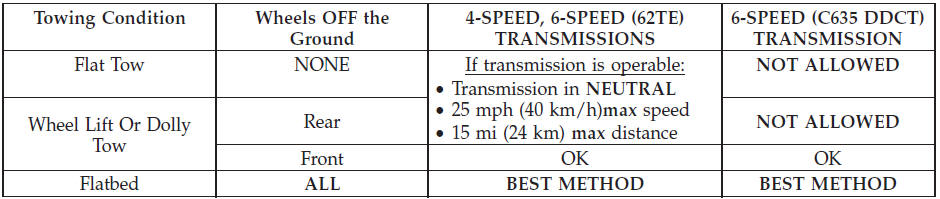
Proper towing or lifting equipment is required to prevent damage to your vehicle. Use only tow bars and other equipment designed for the purpose, following equipment manufacturer’s instructions. Use of safety chains is mandatory. Attach a tow bar or other towing device to main structural members of the vehicle, not to bumpers or associated brackets. State and local laws applying to vehicles under tow must be observed.
If you must use the accessories (wipers, defrosters, etc.) while being towed, the ignition must be in the ON/RUN position, not the ACC position.
CAUTION!
• Do not use sling type equipment when towing.
Damage to the fascia will occur.
• When securing the vehicle to a flatbed truck, do not attach to front or rear suspension components.
Damage to your vehicle may result from improper towing.
• Do not push or tow this vehicle with another vehicle as damage to the bumper fascia and transmission may result.
• If the vehicle being towed requires steering, the ignition switch must be in the ON position, not the LOCK or ACC positions.
See also:
2011 Chrysler 200 Convertible: First Drive
Automotive Lease Guide reports that nearly one out of every two Chryslers
sold in 2010 went to rental-fleet companies, which is nearly triple the average
for non-luxury brands. No doubt the automa ...
Lights On Reminder
If the headlights or parking lights are on after the ignition
is turned OFF, a chime will sound to alert the driver
when the driver’s door is opened. ...
If Engine Fails To Start
WARNING!
• Never pour fuel or other flammable liquids into
the throttle body air inlet opening in an attempt to
start the vehicle. This could result in a flash fire
causing serious personal i ...