
Towing A Disabled Vehicle
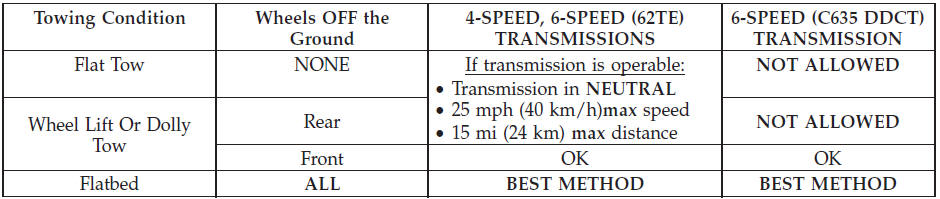
Proper towing or lifting equipment is required to prevent damage to your vehicle. Use only tow bars and other equipment designed for the purpose, following equipment manufacturer’s instructions. Use of safety chains is mandatory. Attach a tow bar or other towing device to main structural members of the vehicle, not to bumpers or associated brackets. State and local laws applying to vehicles under tow must be observed.
If you must use the accessories (wipers, defrosters, etc.) while being towed, the ignition must be in the ON/RUN position, not the ACC position.
CAUTION!
• Do not use sling type equipment when towing.
Damage to the fascia will occur.
• When securing the vehicle to a flatbed truck, do not attach to front or rear suspension components.
Damage to your vehicle may result from improper towing.
• Do not push or tow this vehicle with another vehicle as damage to the bumper fascia and transmission may result.
• If the vehicle being towed requires steering, the ignition switch must be in the ON position, not the LOCK or ACC positions.
See also:
To Disable RKE Transmitter Linked To Memory
1. Turn the ignition switch to the OFF position and
remove the key.
2. Press and release MEMORY button 1. The system will
recall any memory settings stored in position 1. Wait for
the system to ...
Power Windows
The window controls on the driver’s door control all the
door windows.
Power Window Switches
There are single window controls on each passenger door
trim panel, which operate the passenger d ...
Operating Instructions (Uconnect™ Phone) — If Equipped
Refer to “Uconnect™ Phone” in the Uconnect™ User
Manual located on the DVD for further details. ...